
Northwest Territories, CanadaMagnetic latitude 68.6°Population 20,340252 m above sea level
Northern lights in Yellowknife
Yellowknife sits right under the auroral oval: on clear, dark nights the aurora is often overhead, even when activity is quiet. Clouds matter far more than the Kp number here.

Right now
It is still light here. Darkness starts at 19:56.
Updates every minute while this page is open.
Tonight in one minute
Not tonight
- Solar activity Strong enough: Kp 1.7 expected, 0 needed here.
- Sky Overcast (100% cloud).
- Darkness Dark from 19:56 to 06:50.
What to do: Not tonight — your next chance is shown just below.
- Detailed forecast Fri 16 1.7 Good chance · Kp 1.7
- Sat 17 1.7 Good chance · Kp 1.7
- 27-day trend Sun 18 2 Possible · Kp 2
- Mon 19 2 Possible · Kp 2
- Tue 20 3 Good chance · Kp 3
- Wed 21 4 Good chance · Kp 4
- Thu 22 4 Possible · Kp 4
- Fri 23 3 Possible · Kp 3
- Sat 24 2 Possible · Kp 2
- Sun 25 2 Possible · Kp 2
- Mon 26 2 Possible · Kp 2
- Tue 27 2 Possible · Kp 2
- Wed 28 2 Possible · Kp 2
- Thu 29 2 Good chance · Kp 2
- Fri 30 5 Good chance · Kp 5
- Sat 31 5 Good chance · Kp 5
- Sun 1 3 Good chance · Kp 3
- Mon 2 2 Good chance · Kp 2
- Tue 3 2 Good chance · Kp 2
- Wed 4 2 Good chance · Kp 2
- Thu 5 3 Good chance · Kp 3
- Fri 6 3 Good chance · Kp 3
Friday 16 October — Good chance · Kp 1.7 · best around 22:30 · Forecast cloud: 46%. · Reliability: medium
Each box is one night: the colour shows the chance, the number the expected Kp. Tap a night for details.
📅 Add these nights to your calendar — it updates itself (.ics)
How far ahead can the northern lights be forecast?
- Minutes to an hour: satellites 1.5 million km away measure the solar wind before it reaches Earth. This is the surest warning — the “Right now” box uses it.
- 1–3 days: when the Sun throws out a cloud of particles, it takes one to three days to arrive. NOAA's 3-hourly forecast covers these nights; the timing can still be off by a few hours.
- 4–27 days: the Sun turns once every 27 days, and regions that disturbed Earth's field last time often do it again. NOAA's 27-day outlook gives this rough trend — new eruptions are not in it yet.
Tonight
Updated 07:44 local time
Unlikely
Best around 07:00. Forecast max Kp 1.7 (this place needs 0), average cloud 100%.
- Dark enough
- 19:56 – 06:50
- Sunset
- 18:18 · sunrise 08:29
- Moon
- 31% · ↑ 18:01 · ↓ 18:43
- Kp neededKp index: a 0–9 measure of geomagnetic activity. The higher it is, the further from the poles the aurora reaches.
- Kp 0
- Look towards
- north-north-east (18°)
Clearer skies nearby tonight
Forecast cloud during tonight's darkness: 46% here. The clearest option within 100 km is about 100 km to the south, with 15%. Open in OpenStreetMap
MET Norway forecast at 24 points within 100 km, averaged over the dark hours. Check roads and conditions before driving.
Score = activity (NOAA Kp and OVATION) × clear sky (MET Norway) × darkness × moonlight. Methodology
Seeing it right now?
Tell others in Northwest Territories. Reports from real visitors move a place up the live ranking.
Reports are anonymous: we do not store your IP address or location. One report per place every few hours.
What you would see from Yellowknife
Facing north-north-east. Bands show where the aurora sits at two activity levels.
| Kp | What you see | Lower edge | Ray tops | Distance to the aurora |
|---|---|---|---|---|
| 0 | Overhead and all around | – | – | – |
| 2 | Overhead, and also to the south-south-west | – | – | – |
| 3 | Overhead, and also to the south-south-west | – | – | – |
| 4 | Overhead, and also to the south-south-west | – | – | – |
| 5 | Overhead, and also to the south-south-west | – | – | – |
| 6 | Overhead, and also to the south-south-west | – | – | – |
| 7 | Overhead, and also to the south-south-west | – | – | – |
| 8 | Overhead, and also to the south-south-west | – | – | – |
| 9 | Overhead, and also to the south-south-west | – | – | – |
The Kp scale in plain words
Kp is a 0–9 score for how strongly the Earth's magnetic field is being shaken by the solar wind. The higher it goes, the further from the poles the northern lights reach. Kp 0–2 is a quiet night; Kp 5 and above is a geomagnetic storm.
- Kp 0–2 Quiet next 24 h eye in Yellowknife Only under the auroral oval: northern Norway, Swedish and Finnish Lapland, Iceland, Alaska, northern Canada.
- Kp 3 Unsettled Bright in the Arctic; low on the horizon in central Scandinavia and southern Iceland.
- Kp 4 Active Overhead in the Arctic; low in the north from southern Norway, Sweden, Finland and northern Scotland.
- Kp 5 Minor storm (G1) Scotland, southern Scandinavia, the Baltic states, the northern US states and southern Canada.
- Kp 6 Moderate storm (G2) Northern England, Denmark, northern Germany and Poland, the US Midwest — often clearer in photos than to the eye.
- Kp 7 Strong storm (G3) Most of the UK, the Netherlands, Germany, Poland, Czechia; red glow in photos from France and the northern Alps.
- Kp 8 Severe storm (G4) Central Europe to the eye; red sky in photos from northern Italy, Spain, the Balkans and Turkey's Black Sea coast.
- Kp 9 Extreme storm (G5) Seen across Europe and the US; in photos as far south as the Mediterranean, Turkey and North Africa (May 2024).
Light pollution
Suburban sky. Noticeable sky glow. Bright displays are visible, but driving out of town makes a clear difference.
A noticeably darker area starts about 5 km to the north-east. Open in OpenStreetMap
Estimate from NASA VIIRS night-light data (sky-glow model within 50 km). Check access and private land before you go.
Hills and mountains
The horizon towards the north-north-east is open (terrain below 0.2°), so low aurora is not blocked.
From elevation data (AWS Terrain Tiles) along seven lines of sight up to 30 km.
Best months to see the aurora in Yellowknife
Share of nights 2005–2025 that were dark, active enough here and mostly clear.
February has been the best month (78% of nights), followed by March (76%).
| Month | Good nights | Clear nights | Darkness | Low / high |
|---|---|---|---|---|
| September | 60% | 60% | 7.4 h | 6° / 11°C |
| October | 35% | 35% | 10.6 h | -5° / -1°C |
| November | 36% | 36% | 13.3 h | -23° / -16°C |
| December | 66% | 66% | 14.5 h | -31° / -24°C |
| January | 66% | 66% | 13.8 h | -33° / -25°C |
| February | 78% | 78% | 11.5 h | -31° / -23°C |
| March | 76% | 76% | 8.8 h | -23° / -13°C |
| April | 61% | 61% | 4.5 h | -8° / -2°C |
Darkness through the year
- No full darkness (Sun 12° below the horizon) from 1 May to 11 August — the sky stays too bright for most auroras.
- Next new moon 9 November, next full moon 25 October. The darkest skies are in the week around new moon.
Aurora nights in Yellowknife since 1995
Nights when Kp reached 4.7 or more while it was dark here.
Most recent strong nights
- 4 October 2026 · Kp 5.0
- 3 October 2026 · Kp 5.0
- 7 September 2026 · Kp 5.0
- 18 April 2026 · Kp 5.3
- 17 April 2026 · Kp 5.3
- 2 April 2026 · Kp 5.3
- 1 April 2026 · Kp 5.0
- 24 March 2026 · Kp 5.0
Where to watch near Yellowknife
-
Pilots Monument (Old Town)
Rocky lookout over Yellowknife Bay in Old Town, usable year-round for strong displays. · about 2 km · Open in OpenStreetMap
-
Prosperous Lake Boat Launch
First large lake on the Ingraham Trail with a parking area and open northern sky. · about 24 km · Open in OpenStreetMap
-
Madeline Lake Territorial Day Use Area
Popular stop surrounded by boreal forest away from city lights; the lot can be busy on strong nights. · about 27 km · Open in OpenStreetMap
-
Prelude Lake Territorial Park
Lookout trail above the lake facing north, plus shoreline viewing with autumn reflections. · about 34 km · Open in OpenStreetMap
-
Cameron River Crossing Territorial Park
Darker site about 50 minutes out, just before the bridge over the Cameron River. · about 59 km · Open in OpenStreetMap
-
Tibbitt Lake (end of Ingraham Trail)
End of the highway and start of the winter road to the diamond mines, with very little artificial light. · about 73 km · Open in OpenStreetMap
Local knowledge
- Yellowknife has two aurora seasons: late August to early October, when lakes are still open for reflections, and mid-November to early April with snow and frozen lakes.
- Mid-to-late October often brings cloud cover as the lakes freeze, so many operators pause tours until mid-November.
- Strong displays are visible from town, but the Ingraham Trail (Highway 4) leads to darker lakes 25-75 km away.
- Use designated parking lots or day-use areas; never stop or park on the road shoulder, which carries heavy truck traffic.
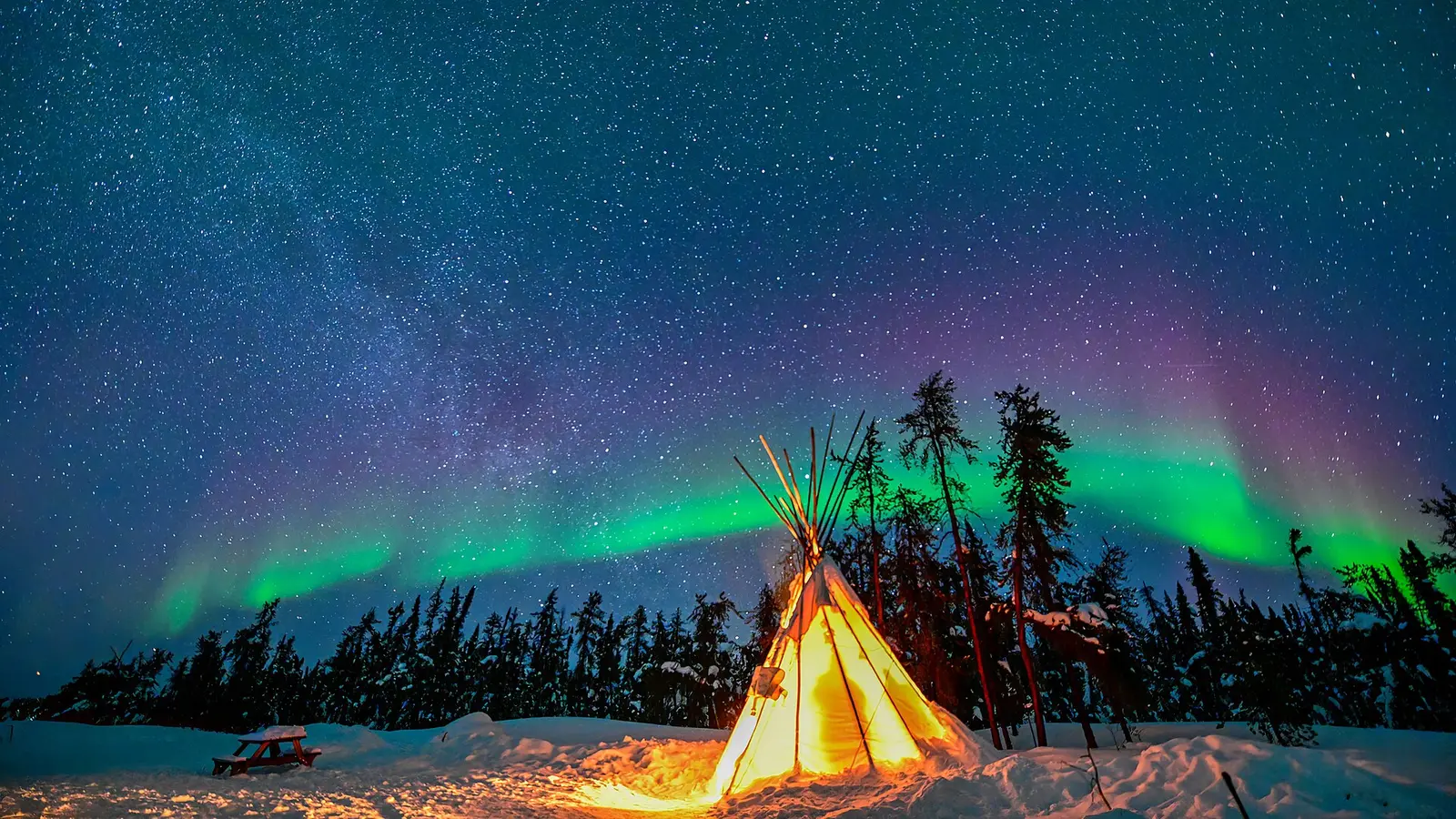
- Several companies offer heated cabin or teepee viewing sites for very cold nights.
Do not drive onto lake ice except where existing vehicle tracks show it is in use, and avoid thin ice near rapids such as at Cameron River.
There is no cell service beyond Tibbitt Lake, and outhouses at the day-use areas are often closed in winter.
Wear bright or reflective clothing near roads; dark winter gear is hard for drivers to see.
Practical information
- Nearest airport
- Yellowknife International Airport (YZF) · 4 km
- Typical low / high in February
- -31° / -23°C
- What to wear
- Extreme cold: insulated boots, down jacket, two layers of wool, face protection, chemical hand warmers. Full clothing guide
- Emergency number
- 911
- Winter driving
- Rules are provincial: Québec requires winter tyres (mountain-snowflake symbol or studded) on Québec-registered vehicles Dec 1–Mar 15, and BC requires winter tyres or chains on signed routes Oct 1–Mar 31 (to Apr 30 on mountain passes/high-snowfall routes); road conditions via 511 Yukon (511yukon.ca), DriveNWT (drivenwt.ca), 511 Alberta, Manitoba 511 (manitoba511.ca) and DriveBC. Road conditions
- Access to land
- There is no national right to roam; private land requires the owner's permission, while national/provincial parks and Crown land are generally accessible subject to park rules, which vary by province and territory.
- Official space-weather service
- Space Weather Canada (Natural Resources Canada)
- Weather service
- Environment and Climate Change Canada (weather.gc.ca)
Questions and answers
What Kp do you need to see the aurora in Yellowknife?
Yellowknife sits right under the auroral oval: on clear, dark nights the aurora is often overhead, even when activity is quiet. Clouds matter far more than the Kp number here.
Which way should I look for the aurora in Yellowknife?
Around Yellowknife the aurora is often right overhead. Start by facing north-north-east, but look up and all around — in strong storms it can fill the whole sky and even appear behind you.
What is the best month to see the aurora in Yellowknife?
Over 2005–2025, February gave the best odds in Yellowknife (78% of nights dark, active enough and mostly clear), followed by March (76%).
When is the aurora season in Yellowknife?
From 1 May to 11 August the sky in Yellowknife never gets dark enough. Outside that period the aurora can be seen whenever activity and clouds allow.
Is there much light pollution in Yellowknife?
Noticeable sky glow. Bright displays are visible, but driving out of town makes a clear difference. A noticeably darker area starts about 5 km to the north-east.
When was the aurora last possible in Yellowknife?
Activity last reached storm level (Kp 5 or more) during darkness in Yellowknife on 4 October 2026 (Kp 5.0) — 747 such nights since 1995. Here the aurora also appears on many quieter nights.
Also covered by this forecast
Villages and districts around Yellowknife share its forecast: within a few kilometres the sky, the Kp needed and the best direction are the same.
- Yellowknife 3 km
- Yellowknife 3 km
- Dettah 6 km
- Dettah 6 km