
Tasmania, AustraliaMagnetic latitude 54.1°1 m above sea level
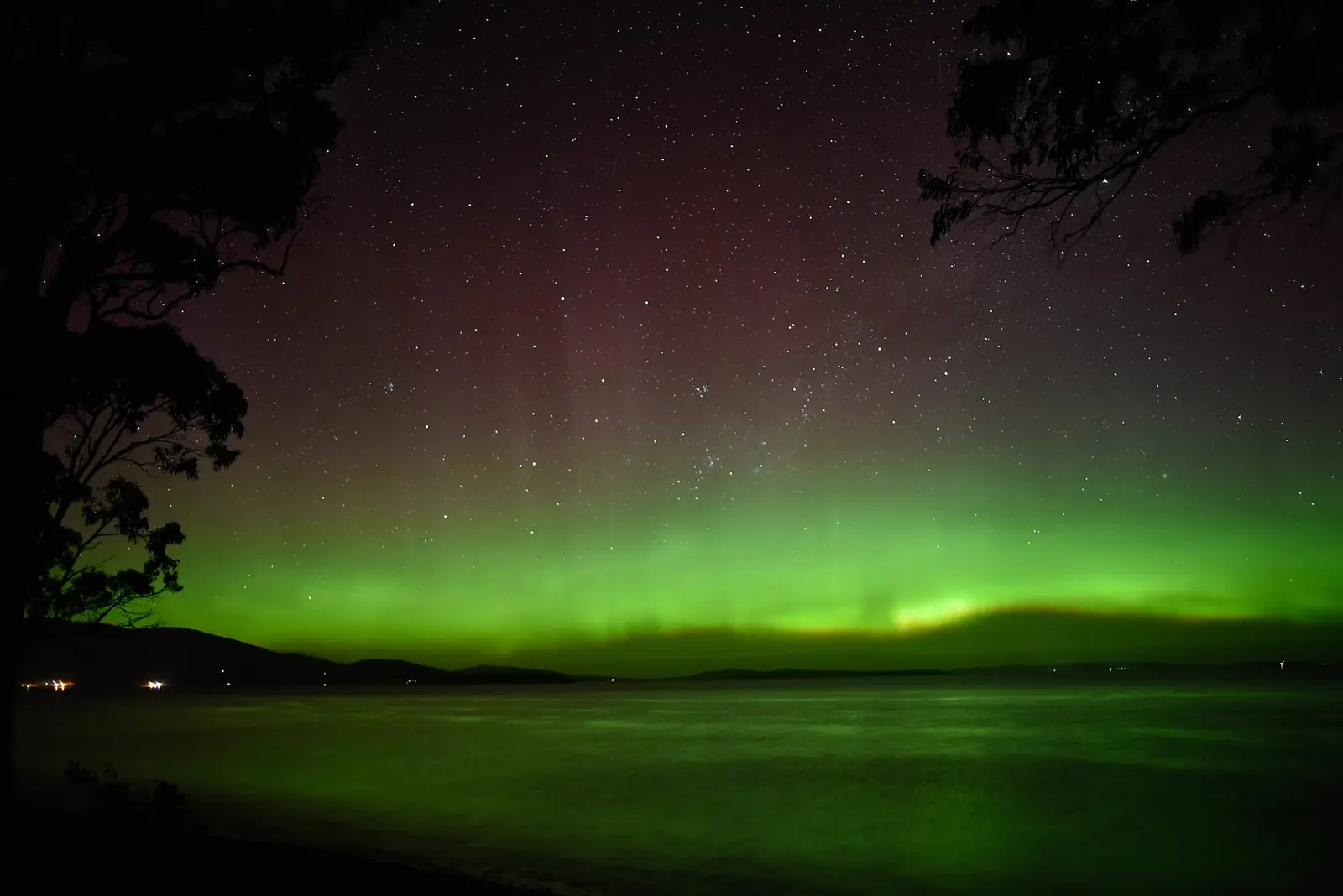
Southern lights in Bruny Island (Alonnah)
Bruny Island (Alonnah) needs an active night: from about Kp 4 the aurora appears low over the south horizon, and it rises higher as activity grows. Since 1995 storms of Kp 4.7 or more reached this place during darkness on 862 nights.

Right now
Quiet right now (Kp 2.0).
Latest measured half-hour activity worldwide: Hp30 2.7.
Updates every minute while this page is open. Ground data: GFZ Potsdam Hp30 index (CC BY 4.0).
Tonight in one minute
Not tonight
- Solar activity Enough for a camera: Kp 3.3 expected, 2.3 needed for photos, 4 for the eye.
- Sky Overcast (80% cloud).
- Darkness Dark from 20:47 to 05:02. A bright moon (76%) washes out faint displays.
What to do: Not tonight — your next chance is shown just below.
Sunday 1 November — Good chance · Kp 5 · best around 00:00 · No cloud forecast this far ahead; in October about 64% of nights are clear here. · Reliability: low (rough trend)
Each box is one night: the colour shows the chance, the number the expected Kp. Tap a night for details.
📅 Add these nights to your calendar — it updates itself (.ics)
How far ahead can the northern lights be forecast?
- Minutes to an hour: satellites 1.5 million km away measure the solar wind before it reaches Earth. This is the surest warning — the “Right now” box uses it.
- 1–3 days: when the Sun throws out a cloud of particles, it takes one to three days to arrive. NOAA's 3-hourly forecast covers these nights; the timing can still be off by a few hours.
- 4–27 days: the Sun turns once every 27 days, and regions that disturbed Earth's field last time often do it again. NOAA's 27-day outlook gives this rough trend — new eruptions are not in it yet.
Tonight
Updated 22:42 local time
Unlikely
Best around 22:00. Forecast max Kp 3.3 (this place needs 4), average cloud 80%.
- Dark enough
- 20:47 – 05:02
- Sunset
- 19:41 · sunrise 06:08
- Moon
- 76% · ↑ 15:18 · ↓ 04:05
- Kp neededKp index: a 0–9 measure of geomagnetic activity. The higher it is, the further from the poles the aurora reaches.
- Kp 4
- Kp for photos
- In photos: from Kp 2.3 (a red glow low in the south).
- Look towards
- south (188°)
Cloud layers and weather
Low cloud blocks the aurora completely. Thin high cloud often still lets a bright aurora shine through, so a sky with only high cloud is worth a look.
| Time | Wed, 22 | Thu, 01 | Thu, 04 | Thu, 22 | Fri, 01 | Fri, 04 | Fri, 22 | Sat, 01 | Sat, 04 |
|---|---|---|---|---|---|---|---|---|---|
| Low cloud | 8% | 3% | 4% | 0% | 0% | 0% | 20% | 33% | 46% |
| Mid cloud | 0% | 0% | 0% | 13% | 0% | 0% | 59% | 35% | 15% |
| High cloud | 59% | 86% | 100% | 35% | 35% | 47% | 47% | 21% | 4% |
| Temperature | 13 °C | 12 °C | 12 °C | 18 °C | 17 °C | 16 °C | 15 °C | 14 °C | 13 °C |
| Feels like | 13 °C | 12 °C | 12 °C | 18 °C | 17 °C | 16 °C | 15 °C | 14 °C | 13 °C |
| Wind | 3 m/s | 3 m/s | 4 m/s | 4 m/s | 7 m/s | 7 m/s | 2 m/s | 2 m/s | 1 m/s |
Cloud layers and weather: Open-Meteo (CC BY 4.0).
Clearer skies nearby tonight
Tonight's cloud forecast is similar in every direction within 100 km (80% here), so driving is unlikely to help.
MET Norway forecast at 24 points within 100 km, averaged over the dark hours. Check roads and conditions before driving.
Score = activity (NOAA Kp and OVATION) × clear sky (MET Norway) × darkness × moonlight. Methodology
Weather in Bruny Island (Alonnah)
The aurora only shows through clear skies, so the weather matters as much as the Kp index. Here is the general forecast for Bruny Island (Alonnah): temperature, wind and the chance of rain for the coming days.
Seeing it right now?
Tell others in Tasmania. Reports from real visitors move a place up the live ranking.
Reports are anonymous: we do not store your IP address or location. One report per place every few hours.
Do you host guests in Bruny Island (Alonnah)? Give them a free aurora forecast page and a QR poster for your property. Create a guest page →
What you would see from Bruny Island (Alonnah)
Facing south. Bands show where the aurora sits at two activity levels.
| Kp | What you see | Lower edge | Ray tops | Distance to the aurora |
|---|---|---|---|---|
| 2 | Below the horizon | 2° | 8° | 934 km |
| 3 | Faint glow, mostly on camera | 5° | 12° | 712 km |
| 4 | Visible to the south | 10° | 20° | 489 km |
| 5 | Visible to the south | 20° | 35° | 267 km |
| 6 | Visible to the south | 67° | 77° | 44 km |
| 7 | Overhead and all around | – | – | – |
| 8 | Overhead, and also to the north | – | – | – |
| 9 | Overhead, and also to the north | – | – | – |
The Kp scale in plain words
Kp is a 0–9 score for how strongly the Earth's magnetic field is being shaken by the solar wind. The higher it goes, the further from the poles the northern lights reach. Kp 0–2 is a quiet night; Kp 5 and above is a geomagnetic storm.
- Kp 0–2 Quiet camera in Bruny Island (Alonnah) Only under the auroral oval: northern Norway, Swedish and Finnish Lapland, Iceland, Alaska, northern Canada.
- Kp 3 Unsettled next 24 h Bright in the Arctic; low on the horizon in central Scandinavia and southern Iceland.
- Kp 4 Active eye in Bruny Island (Alonnah) Overhead in the Arctic; low in the north from southern Norway, Sweden, Finland and northern Scotland.
- Kp 5 Minor storm (G1) Scotland, southern Scandinavia, the Baltic states, the northern US states and southern Canada.
- Kp 6 Moderate storm (G2) Northern England, Denmark, northern Germany and Poland, the US Midwest — often clearer in photos than to the eye.
- Kp 7 Strong storm (G3) Most of the UK, the Netherlands, Germany, Poland, Czechia; red glow in photos from France and the northern Alps.
- Kp 8 Severe storm (G4) Central Europe to the eye; red sky in photos from northern Italy, Spain, the Balkans and Turkey's Black Sea coast.
- Kp 9 Extreme storm (G5) Seen across Europe and the US; in photos as far south as the Mediterranean, Turkey and North Africa (May 2024).
Light pollution
Pristine dark sky. Almost no artificial light: faint aurora and the Milky Way are easy to see.
Estimate from NASA VIIRS night-light data (sky-glow model within 50 km). Check access and private land before you go.
Hills and mountains
The terrain rises to about 4° above the horizon towards the south. That hides low aurora: here you need about Kp 4 instead of Kp 4. A hilltop, shore or open field with a clear view to the south helps.
From elevation data (AWS Terrain Tiles) along seven lines of sight up to 30 km.
Best months to see the aurora in Bruny Island (Alonnah)
Share of nights 2005–2025 that were dark, active enough here and mostly clear.
August has been the best month (8% of nights), followed by April (8%).
| Month | Good nights | Clear nights | Darkness | Low / high |
|---|---|---|---|---|
| March | 7% | 65% | 9.5 h | 8° / 19°C |
| April | 8% | 66% | 11.0 h | 7° / 15°C |
| May | 7% | 61% | 12.0 h | 5° / 12°C |
| June | 8% | 64% | 12.8 h | 4° / 10°C |
| July | 6% | 59% | 12.4 h | 3° / 9°C |
| August | 8% | 65% | 11.5 h | 3° / 10°C |
| September | 8% | 67% | 9.9 h | 4° / 12°C |
| October | 8% | 64% | 8.5 h | 5° / 14°C |
Aurora nights in Bruny Island (Alonnah) since 1995
Nights when Kp reached 4.7 or more while it was dark here.
Most recent strong nights
- 10 October 2026 · Kp 7.3
- 4 October 2026 · Kp 5.0
- 18 August 2026 · Kp 5.3
- 8 August 2026 · Kp 6.0
- 2 August 2026 · Kp 5.7
- 23 July 2026 · Kp 5.0
- 4 July 2026 · Kp 6.7
- 5 June 2026 · Kp 6.0
Where to watch near Bruny Island (Alonnah)
-
The Neck Lookout
Stairway lookout on the narrow isthmus between North and South Bruny with open views in all directions and campervan parking. · about 16 km · Open in OpenStreetMap
-
Cloudy Bay
Long south-facing surf beach in South Bruny National Park with a dark, open southern horizon. · about 18 km · Open in OpenStreetMap
-
Cape Bruny Lighthouse
Historic 1836 lighthouse on a southern headland, a recognised aurora photography spot with no town lights nearby. · about 26 km · Open in OpenStreetMap
Local knowledge
- The vehicle ferry runs from Kettering, about 40 minutes' drive south of Hobart, with a crossing of around 20 minutes; check the last return sailing if you are not staying overnight.
- South Bruny, especially The Neck and Cloudy Bay, has unobstructed southern horizons with very little artificial light.
- Climb the stairs to the lookout at The Neck and aim your camera south for the classic Bruny aurora view.
- Winter (May to August) gives the longest nights; check aurora alerts and cloud cover before heading out.
- Staying on the island overnight (e.g. at campgrounds in South Bruny National Park) lets you react quickly when an aurora alert is issued.
Cape Bruny Lighthouse grounds have unprotected cliff edges; use a torch and keep well back in the dark.
A valid Tasmanian parks pass is required in South Bruny National Park, where pets are not allowed.
Some South Bruny campsites and tracks (e.g. Cloudy Corner) require a 4WD.
Practical information
- Typical low / high in August
- 3° / 10°C
- What to wear
- Cool nights: layers, a windproof jacket, hat and gloves for standing still outside. Full clothing guide
- Emergency number
- 000 (112 also works from mobile phones)
- Winter driving
- Under Victoria's Alpine Resorts (Management) Regulations 2020, every vehicle entering Falls Creek, Mt Baw Baw, Mt Buller, Mt Hotham and Mt Stirling must carry fitting wheel chains during the declared snow season (2026: 7 June - 4 October). Check VicTraffic for live Victorian road disruptions; in Tasmania, elevated roads get snow and ice in winter and closures are posted via Tasmania Police alerts / TasALERT. Road conditions
- Access to land
- Most Tasmanian national parks require a valid Parks & Wildlife Service parks pass per vehicle (24-hour, holiday/8-week, annual options; Cradle Mountain excluded from the 24-hour pass). Check land tenure before parking at night and respect any local closures.
- Official space-weather service
- Bureau of Meteorology Australian Space Weather Forecasting Centre (Aurora Watch/Alert/Outlook)
- Weather service
- Bureau of Meteorology
Questions and answers
What Kp do you need to see the aurora in Bruny Island (Alonnah)?
Bruny Island (Alonnah) needs an active night: from about Kp 4 the aurora appears low over the south horizon, and it rises higher as activity grows.
Which way should I look for the aurora in Bruny Island (Alonnah)?
Face south (about 188° from true north). At Kp 4 the lower edge of the aurora sits roughly 10° above the horizon; stronger activity lifts it higher and further across the sky.
What is the best month to see the aurora in Bruny Island (Alonnah)?
Over 2005–2025, August gave the best odds in Bruny Island (Alonnah) (8% of nights dark, active enough and mostly clear), followed by April (8%).
When is the aurora season in Bruny Island (Alonnah)?
Bruny Island (Alonnah) gets dark enough for the aurora all year round, though the long winter nights give the most hours to watch.
Is there much light pollution in Bruny Island (Alonnah)?
Almost no artificial light: faint aurora and the Milky Way are easy to see.
When was the aurora last possible in Bruny Island (Alonnah)?
Activity last reached storm level (Kp 5 or more) during darkness in Bruny Island (Alonnah) on 10 October 2026 (Kp 7.3) — 862 such nights since 1995. Here the aurora also appears on many quieter nights.
Also covered by this forecast
Villages and districts around Bruny Island (Alonnah) share its forecast: within a few kilometres the sky, the Kp needed and the best direction are the same.
- Alonnah 0 km
- Simpsons Bay 6 km
- Gordon 6 km
- Lunawanna 6 km
- Adventure Bay 8 km
- Verona Sands 8 km
- Middleton 9 km
- Charlotte Cove 9 km
- Garden Island Creek 11 km
- Randalls Bay 12 km
- South Bruny 14 km
- Eggs And Bacon Bay 14 km
- Birchs Bay 15 km
- Police Point 18 km